 comparison
Venetian Plaster vs Faux Paint Finishes for Luxury Walls
Last Updated: November 8, 2026
Quick Summary
Choosing venetian plaster vs faux paint finishes comes down to whether you want real mineral material or a painted illusion. Venetian plaster is lime-based, trowel-applied in layers that cure stone-like, while faux finishes imitate that look with glaze, texture medium, or joint compound.
- Venetian plaster is made from slaked lime, marble dust, and natural pigments applied in thin trowel coats.
- Faux plaster paint builds depth with glaze layering, texture medium, joint compound, or color washing.
- Venetian plaster texture comes from the material itself, so it holds up in raking light.
- Faux Venetian plaster with joint compound dries chalky, feels less dense, and chips more at edges.
- Sealer on Venetian plaster can be refreshed without recoating the plaster itself.
Table of Contents
- Venetian Plaster vs Faux Paint Finishes: A Side-by-Side Comparison
- What Is Venetian Plaster and How Is It Applied?
- The Faux Plaster Paint Technique Explained
- Venetian Plaster Wall Texture vs Faux Paint Texture
- Venetian Plaster Paint Colors and Faux Paint Color Options
- Faux Venetian Plaster with Joint Compound: What to Expect
- Durability, Maintenance, and Lifecycle Cost in South San Francisco
- Choosing Your Finish: Next Steps for Your South San Francisco Project
- Frequently Asked Questions
Venetian Plaster vs Faux Paint Finishes: A Side-by-Side Comparison
Choosing between venetian plaster vs faux paint finishes comes down to one question: do you want real mineral material on the wall, or a painted illusion of it? Venetian plaster is a lime-based coating built from thin, trowel-applied layers that cure into a stone-like surface. Faux paint finishes are decorative painting techniques that imitate that look with glaze, texture medium, or joint compound. The honest answer is that they serve different budgets, timelines, and expectations.
Here is the part most guides skip: the two finishes can look nearly identical in a photograph and feel completely different under your hand. One has depth you can see in raking light. The other has a surface that stays flat no matter how the sun moves across it.
Below, we break down how each is applied, how they age, and which one fits your project.
Quick Comparison Table: Cost, Durability, and Application
| Factor | Venetian Plaster | Faux Paint Finishes |
|---|---|---|
| Material base | Lime putty and marble dust | Paint, glaze, texture medium |
| Application | Three or more trowel coats, burnished | Roller, brush, sponge, or trowel |
| Skill level | High; trained plasterer | Moderate to high for convincing results |
| Depth and movement | Inherent in the material | Created with layered glaze |
| Durability | Long service life with care | Varies widely by technique |
| Repair | Patchable by a skilled hand | Often requires repainting the wall |
| Timeline | Slower, cure-dependent | Faster on most walls |
| Best for | Feature walls, lobbies, luxury interiors | Budget-conscious rooms, quick refreshes |
Pricing for either finish depends on wall size, substrate condition, and detail work, so we recommend requesting a quote for current pricing.
What Is Venetian Plaster and How Is It Applied?
Venetian plaster is a decorative wall finish made from slaked lime, marble dust, and natural pigments, applied in multiple thin coats with a stainless steel trowel and burnished to a polished or matte sheen. The material hardens through a chemical reaction with air, not by drying like paint.
Application follows a set sequence:
- Surface preparation. The substrate is cleaned, patched, and primed so the plaster bonds evenly.
- Base coat. A first layer establishes the ground and hides minor imperfections.
- Build coats. Two or more thin layers follow, each pressed tight with the trowel.
- Burnishing. Pressure from the trowel compresses the surface into a sheen.
- Sealing. A breathable sealer protects the finish while letting moisture escape.
The result is a handcrafted finish with genuine dimension. No two walls come out the same, which is exactly the point.
The Faux Plaster Paint Technique Explained
The faux plaster paint technique is a painting method that recreates the look of plaster using paint and specialty products rather than lime. A base coat goes down first, then translucent glazes or texture mediums are worked over it with brushes, rags, sponges, or a putty knife to build the illusion of depth.
Common approaches include:
- Glaze layering for a soft, cloudy marble effect
- Texture medium rolled or stippled on for surface tooth
- Joint compound troweled thin for a plaster-like ridge
- Color washing for a mottled, aged appearance
Faux finishes are versatile and forgiving to learn. The trade-off is that the depth is painted on, so it sits at the surface rather than inside the material. Up close, a trained eye can usually tell. If you want to see the range of motifs we produce, browse our faux paintings in marble, stone, and wood.
Venetian Plaster Wall Texture vs Faux Paint Texture
Texture is where the two finishes separate for good. Venetian plaster wall texture comes from the material itself: trowel pressure, mineral grain, and burnishing create subtle highs and lows that shift as light moves across the wall. Faux paint texture is applied on top of a flat surface, so the wall still reads as painted when you run a hand over it.
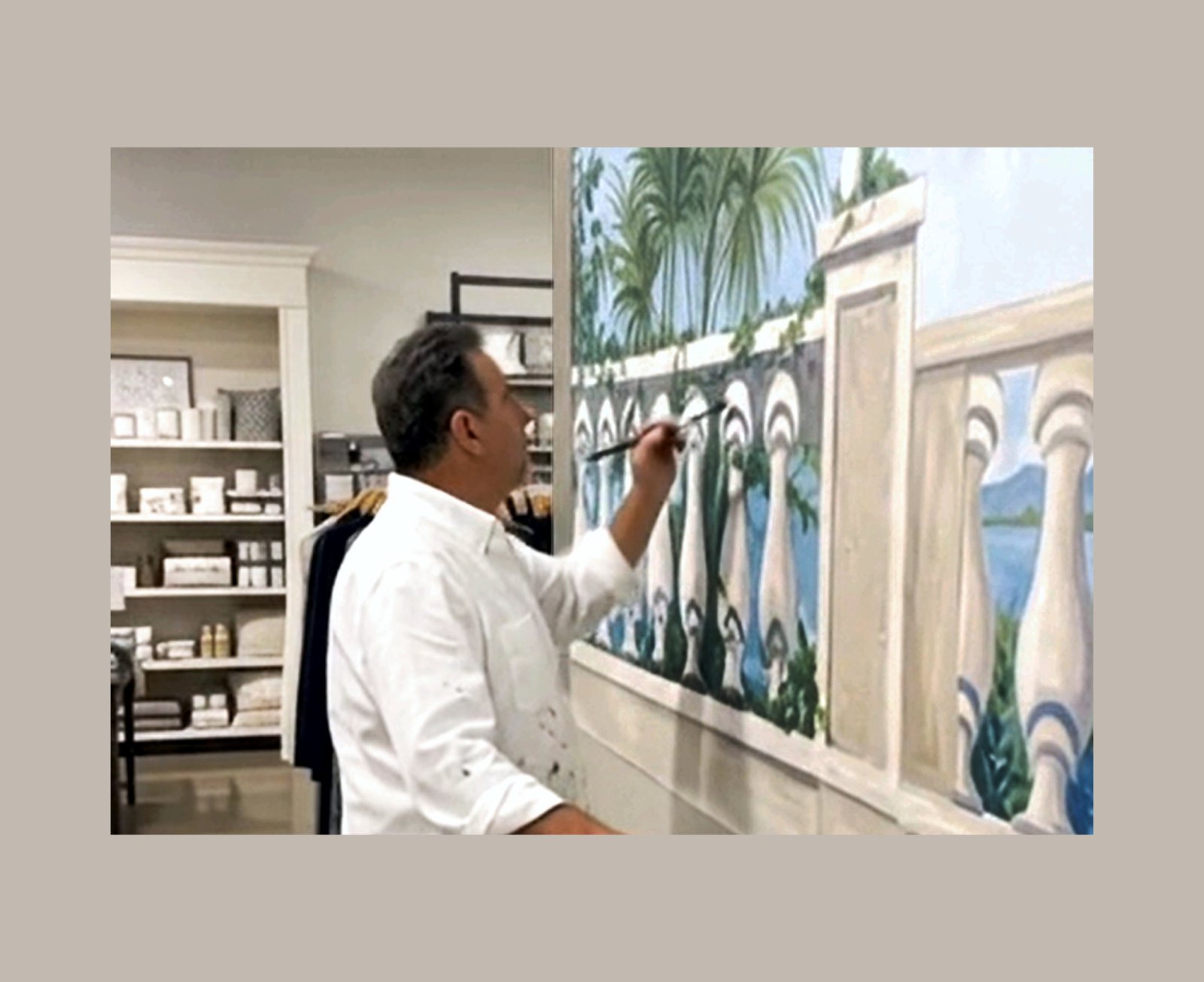
In practice, this means Venetian plaster holds up to scrutiny in raking light, the kind you get from a window or a well-placed sconce. Faux finishes look strongest in softer, diffused light. Neither is wrong. They just reward different rooms.
Venetian Plaster Paint Colors and Faux Paint Color Options
Color behaves differently in each finish. Venetian plaster paint colors tend to read as mineral and earthy, with warm neutrals, soft grays, and modern earth tones dominating luxury interiors. Because the pigment sits inside the plaster, the color has a subtle luminosity that shifts with the sheen.
Faux paint color options are effectively unlimited. Any paint color can be glazed, layered, or washed, which makes faux finishes the more flexible choice when you are matching an existing palette or chasing a very specific hue.
Two practical notes:
- Always approve a sample board in the actual room. Wall color changes with daylight, lamp temperature, and surrounding finishes.
- Ask for a larger sample on Venetian plaster. The movement across a full wall is hard to judge from a small swatch.
For curated direction, our guide to the best Venetian plaster colors for luxury interiors walks through the shades that hold up best in high-end spaces.
Faux Venetian Plaster with Joint Compound: What to Expect
Faux Venetian plaster with joint compound is the budget route, and it can look convincing in the right hands. The technique spreads thin layers of joint compound over a primed wall, trowels them smooth, then seals and sometimes waxes the surface for sheen. Unlike lime plaster, joint compound does not harden through a chemical reaction with air; it dries as the water evaporates, which is why the cured surface feels chalkier and less dense than the real material.
The application sequence matters more than most guides admit:
- Substrate check. The wall must be sound, clean, and free of peeling paint. Joint compound adheres poorly to glossy or dusty surfaces, so a bonding primer is usually required.
- Base layer. A thin skim coat establishes a uniform ground and fills minor imperfections.
- Build layers. Two or more thin coats follow, each troweled tight and allowed to dry fully before the next.
- Burnish or smooth. A final pass with a trowel or damp sponge compresses the surface and reduces trowel ridges.
- Seal. A sealer or wax locks the surface and adds sheen. Without it, joint compound dusts and scuffs.
What to expect honestly:
- It looks good at a distance. From across a room, a skilled job reads as plaster. Up close, the surface lacks the mineral grain and depth of lime.
- It feels different. Joint compound dries chalky and light. Real plaster feels dense and cool to the touch.
- It is less forgiving over time. Joint compound is softer and more prone to chipping at edges and corners, especially in high-traffic hallways.
- Repairs are simpler. Matching a patch is usually easier than with lime plaster, because the material is more uniform and the color is in the sealer or paint rather than in the plaster itself.
- Removal is easier. Joint compound softens with water and can often be scraped or sanded back, while lime plaster is harder to remove and may require mechanical abrasion.
For a hallway, a rental, or a staging refresh, this approach earns its place. For a lobby or a feature wall you plan to live with for decades, we steer clients toward the real material. The gap between the two is not just visual; it is in how the surface behaves under moisture, impact, and time.
Durability, Maintenance, and Lifecycle Cost in South San Francisco
Durability depends on how the finish is sealed, where it lives in the house, and how the substrate was prepared. Faux finishes depend entirely on the technique and topcoat: a well-sealed glaze can last years, while an unsealed texture coat may scuff and dull faster.
Maintenance looks like this:
- Cleaning. Both finishes wipe down with a damp cloth and mild soap. Avoid abrasive pads and ammonia-based cleaners, which can dull a burnished sheen.
- Repair. Venetian plaster patches can blend well in skilled hands because the material is built in layers.
- Reapplication. Sealer on Venetian plaster can be refreshed periodically without recoating the plaster itself. Faux finishes often mean repainting the entire wall when the topcoat fails.
Sealed faux finishes trap moisture differently, so substrate prep and primer choice carry more weight. Our guide on how to clean, repair, and maintain Venetian plaster walls covers the upkeep routine in detail.
Lifecycle cost comparison. A transparent way to compare the two is to look at the full sequence of spend over a ten-year horizon, not just the install invoice.
Watch out: a low faux bid that skips primer or topcoat can look fine for a season and then fail at the edges, which erases the upfront savings and adds a repaint to the budget.
Choosing Your Finish: Next Steps for Your South San Francisco Project
The decision comes down to three questions. How long will you live with the wall? How closely will people look at it? And what is your budget for the install itself?
If the answer is a decade or more, in a room guests actually touch and study, Venetian plaster is the stronger investment. If you need impact fast and the wall is transitional, a well-executed faux finish delivers real value.
Both finishes can be considered for your space. Contact NuArts Production to discuss your project. Explore our mural art services for faux finishes and Venetian plaster. Explore our Custom Murals & Faux Finishes or book a Free Consultation and Estimates to talk through your project.
Frequently Asked Questions
Is Venetian plaster in style in 2026?
Yes. Venetian plaster remains a favored choice for luxury interiors, with warm neutrals and modern earth tones leading current color trends. Its handcrafted depth and movement continue to appeal to designers working on high-end residential and hospitality projects. In the San Francisco Bay Area, demand is steady for feature walls, fireplace surrounds, and commercial lobbies where a bespoke finish sets the tone for the space.
Can I paint over a Venetian plaster finish?
You can, but it changes the character of the wall. A coat of paint fills the subtle variations that give Venetian plaster its depth, so the surface reads as flat. If the plaster is sound, a fresh coat of paint is a budget-friendly way to update the color. If you want to keep the plaster look, a new layer of plaster or a limewash is a better route than standard paint.
What are the downsides of Venetian plaster?
Venetian plaster is a skilled trade, so labor is the largest part of the budget and timelines depend on the craftsman's schedule. It takes multiple thin coats with drying time between them, so a feature wall can take several days. It also shows imperfections in the substrate, which means proper surface preparation is essential. Poor prep or rushed application is the main reason a plaster finish cracks or fails.
How does faux Venetian plaster with joint compound compare with real Venetian plaster?
Faux Venetian plaster with joint compound uses drywall mud to mimic the look of real plaster at a lower material cost. It can create a convincing texture for a feature wall, but it lacks the mineral composition, breathability, and burnished sheen of lime-based plaster. Over time, joint compound is more prone to cracking and moisture damage, so it suits lower-traffic areas better than commercial spaces.
Which finish is easier to maintain: Venetian plaster or faux paint?
Both are low-maintenance when applied correctly. Faux paint is easy to touch up with leftover paint, but it may need repainting sooner in high-traffic areas. In commercial settings, sealed Venetian plaster generally holds up better to repeated cleaning.